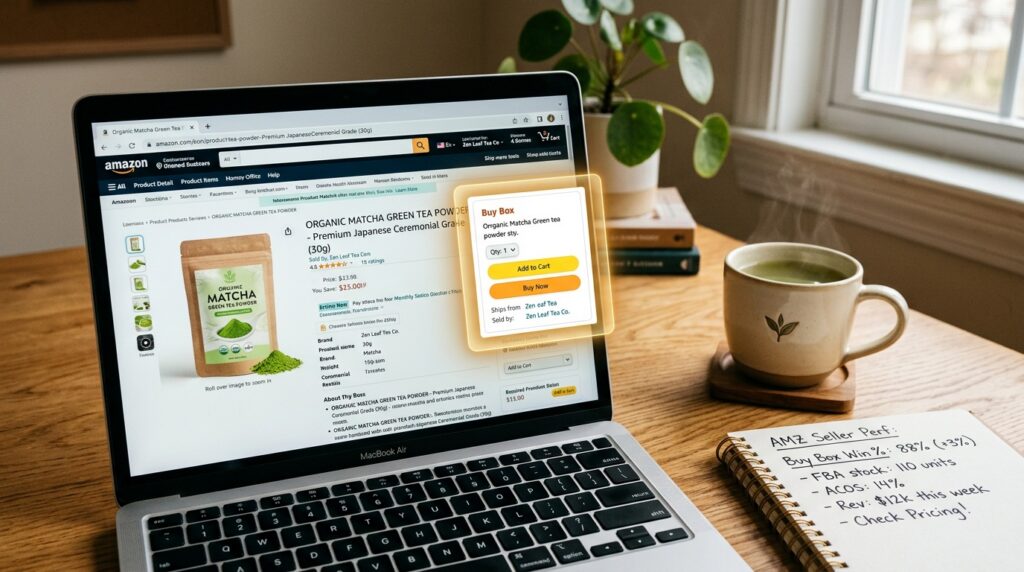
Why the Buy Box Matters More Than Most Sellers Realise
If you sell on Amazon, the Buy Box is arguably the single most valuable piece of digital real estate on the platform. It’s the white box on the right-hand side of a product detail page that contains the “Add to Basket” and “Buy Now” buttons. When a shopper clicks either of those buttons, they’re buying from whichever seller currently holds the Buy Box — and that seller takes the sale.
Research consistently shows that the vast majority of Amazon purchases — often cited at over 80% — go through the Buy Box. For sellers competing on the same listing, not winning it means not making sales. Yet many sellers, particularly those new to Amazon, don’t fully understand how the Buy Box works or what they can do to improve their chances of winning it consistently.
This guide breaks down exactly how Amazon determines Buy Box eligibility, what factors carry the most weight, and the concrete steps you can take to compete more effectively.
Who Is Eligible for the Buy Box?
Not every seller can compete for the Buy Box. Amazon reserves it for sellers who meet certain baseline performance thresholds. These typically include:
- Having a Professional selling account (Individual accounts are generally not Buy Box eligible)
- Maintaining a strong Order Defect Rate — Amazon generally expects this to remain below 1%
- Meeting minimum requirements for Late Shipment Rate and Pre-fulfilment Cancellation Rate
- Having sufficient sales history on the platform
Even if you meet these thresholds, eligibility isn’t guaranteed on every product you list. Amazon assesses eligibility at the ASIN level, so a seller might be eligible on some listings but not others depending on their performance history and account standing.
The Key Factors Amazon Uses to Determine Buy Box Winners
Amazon doesn’t publish a precise formula for Buy Box selection, and the weighting of individual factors can vary by product category, time of year, and competitive context. However, based on Amazon’s own guidance and the experience of sellers, the following factors are consistently among the most influential.
Fulfilment Method
How you fulfil orders has a significant impact on your Buy Box performance. Sellers using Fulfilment by Amazon (FBA) tend to have a structural advantage, because Amazon controls the delivery experience end to end — fast, reliable shipping, returns handling, and Prime eligibility are all built in. Sellers using Seller Fulfilled Prime (SFP) can achieve similar outcomes, but only if they consistently meet Amazon’s demanding performance standards. Merchants fulfilling orders themselves (FBM) can still win the Buy Box, but they need to be particularly strong across other metrics to compensate.
Landed Price
Amazon considers the total price a customer pays, including the item price plus shipping. This is sometimes called the landed price. You don’t need to be the cheapest seller on a listing to win the Buy Box, but pricing that’s significantly above the competitive range will work against you. Automated repricing tools can help you stay competitive without constantly monitoring prices manually, though you should be careful not to engage in pricing so aggressive that it damages your margins.
Seller Performance Metrics
Amazon assesses a range of seller performance indicators when calculating Buy Box share. The most important include:
- Order Defect Rate (ODR): This covers negative feedback, A-to-z Guarantee claims, and credit card chargebacks. Keep it well below 1%.
- Late Shipment Rate: Orders dispatched after the expected ship date hurt your score. Amazon expects this below 4%, though the lower the better.
- Valid Tracking Rate: For FBM sellers especially, providing valid tracking information on the majority of shipments is increasingly important.
- Customer Feedback Rating: A higher average seller rating generally supports Buy Box performance. Proactively requesting feedback from satisfied customers, within Amazon’s guidelines, can help build this over time.
Inventory Availability
If you run out of stock, you can’t win the Buy Box. Amazon also factors in your ability to fulfil demand reliably, not just whether you have units available right now. Sellers who regularly go out of stock or have inconsistent inventory levels tend to perform worse in Buy Box calculations. Keeping healthy stock levels, especially during peak periods, is essential.
Shipping Time
Faster promised delivery times work in your favour. This is one reason FBA holds such a strong position — Prime two-day or next-day delivery is difficult to match through self-fulfilment unless you have very efficient logistics in place.
Common Mistakes That Cost Sellers the Buy Box
Many sellers lose Buy Box share not because of a single dramatic failure, but because of small, ongoing issues that quietly drag down their metrics. The most frequent mistakes include:
- Letting inventory run low or going out of stock on popular ASINs
- Setting shipping templates with unrealistically long handling times
- Ignoring negative feedback and failing to address customer service issues promptly
- Pricing products without accounting for competitor prices — either too high to be competitive, or too low to be sustainable
- Failing to monitor Seller Central metrics regularly enough to catch problems before they worsen
At Smartbuyers, we regularly help sellers identify exactly these kinds of performance gaps through structured account reviews, because the issues are often visible in the data long before they result in account warnings.
Practical Steps to Improve Your Buy Box Performance
If you’re currently losing Buy Box share or you’re just starting to compete more seriously, here are the most impactful actions you can take:
- Audit your seller metrics weekly. Open Seller Central and review your Account Health dashboard regularly. Don’t wait for Amazon to contact you.
- Review your fulfilment setup. If you’re currently fulfilling orders yourself and struggling to compete, consider whether FBA or SFP makes sense for your catalogue and margin structure.
- Use a repricer — carefully. Automated repricing tools can help you stay competitive on price without constant manual effort, but configure them with sensible floors so you don’t race to the bottom.
- Improve your feedback rate. Request feedback from customers using Amazon’s “Request a Review” tool (available in Seller Central), which sends a compliant, template message. More positive feedback strengthens your overall seller profile.
- Manage stock proactively. Use sales velocity data to forecast when to reorder. If you use FBA, track your inbound shipment timelines and build in buffer time during busy periods.
- Respond to customer messages promptly. Amazon measures your response rate and time. Staying within the 24-hour window — even with a brief holding reply — matters.
The Buy Box Is Not Winner-Takes-All
It’s worth noting that Amazon sometimes rotates Buy Box ownership among eligible sellers, particularly when multiple sellers are closely matched on price, fulfilment, and performance. This means that even if you don’t hold the Buy Box 100% of the time, improving your metrics can meaningfully increase your share — and therefore your revenue — on a given listing.
Think of Buy Box performance as a long-term investment in your account health and operational standards rather than a single setting you can switch on. The sellers who consistently win are those who treat performance management as an ongoing discipline rather than a one-off fix.
Getting Further Support
Understanding the Buy Box is just one piece of building a strong Amazon presence. If you’re looking for broader guidance on optimising your Amazon account, from listing quality through to advertising and fulfilment strategy, the resources and practical advice available through our e-commerce guides are a useful starting point for sellers at any stage.
The most important thing is to start with your data. Log into Seller Central, check your Account Health, look at your Buy Box percentage on your key ASINs, and identify where the gaps are. Small, consistent improvements across fulfilment, pricing, and performance metrics add up — and they’re entirely within your control.