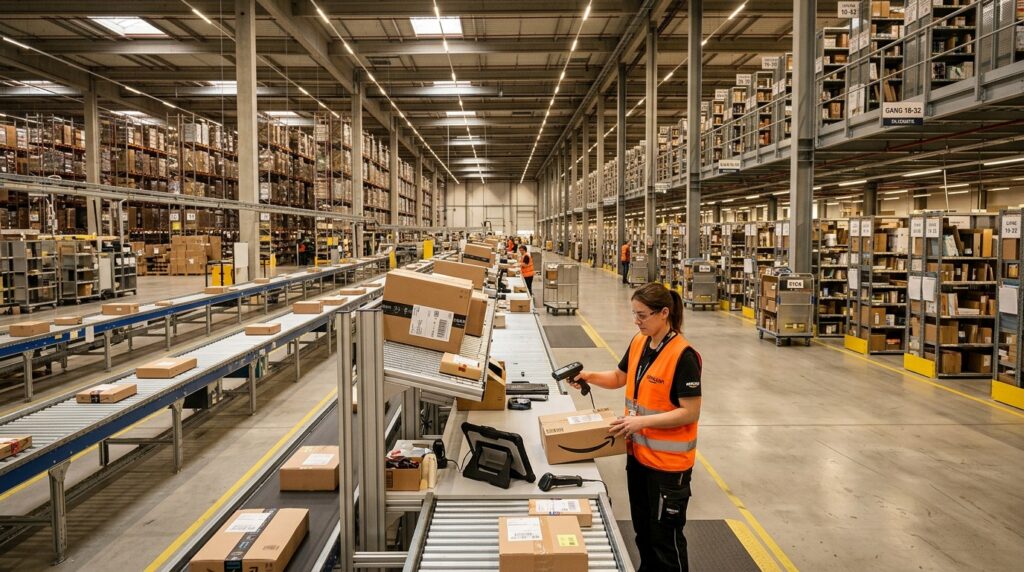
Why Cross-Border Fulfilment Is the Bottleneck for So Many European Sellers
Selling across multiple European countries sounds straightforward on paper. You list your products, set your prices, and wait for orders to roll in from Germany, France, Spain, Italy, and beyond. In practice, however, the logistics side of things can quickly become a significant obstacle. Shipping times that disappoint customers, complicated customs paperwork, VAT obligations in multiple countries, and the sheer cost of holding inventory in several locations simultaneously — these are the real barriers that prevent sellers from scaling across Europe with any confidence.
Amazon’s European Fulfilment Network, commonly referred to as the EFN, was designed to remove many of these barriers. If you’re already using Fulfilment by Amazon (FBA) and storing inventory in one country, the EFN allows you to sell to customers across Europe without needing to hold stock in every marketplace you want to serve. It sounds simple, and in many ways it is — but there are important trade-offs, costs, and strategic choices involved that every seller should understand before committing to a particular fulfilment approach.
What the European Fulfilment Network Actually Does
When you enrol in the EFN, Amazon uses your existing FBA inventory — held in a single fulfilment centre in one country — to fulfil orders placed on any of Amazon’s European marketplaces. So if your stock sits in an Amazon warehouse in Poland, a customer in France who buys your product will still receive it, shipped from Poland, within Amazon’s standard delivery timeframe for cross-border orders.
This is a meaningful advantage for sellers who are just beginning to expand across Europe and don’t yet have the sales volume to justify splitting their inventory across multiple countries. You keep your logistics centralised, your VAT situation relatively straightforward (at least initially), and you don’t take on the financial risk of distributing stock to markets you’re not yet confident about.
The EFN is available to sellers with a Unified European Seller Account, which allows you to list across Amazon’s European stores — including Amazon.de, Amazon.fr, Amazon.it, Amazon.es, Amazon.nl, and Amazon.se — from a single account. sellers looking to grow across Europe will typically find this unified structure far more manageable than maintaining separate seller accounts in each country.
The Costs You Need to Understand
The EFN is convenient, but it isn’t free in the sense that cross-border fulfilment carries higher fees than domestic fulfilment. When an order crosses national borders within the network, Amazon charges EFN fees, which are higher than the standard FBA fulfilment fees you’d pay for a domestic shipment. These fees vary depending on the origin and destination country, the product category, and the size and weight of the item.
For lower-value or lightweight products, EFN fees can erode your margins significantly. This is one of the most common mistakes sellers make when expanding across Europe: they see the market opportunity, activate the EFN, and then discover their profitability on cross-border orders is far lower than expected. Before activating the EFN, it’s worth modelling your margins carefully for each destination market using Amazon’s fee calculators and adjusting your pricing accordingly.
- EFN fulfilment fees are charged per unit and vary by origin/destination country pair
- Storage fees remain the same as standard FBA storage — they depend on the size and duration of storage
- Return processing fees apply when customers return items, as with standard FBA
- VAT obligations may still arise in destination countries depending on your sales thresholds — particularly relevant since the EU’s One Stop Shop (OSS) VAT scheme came into effect
Understanding the VAT implications is particularly important. The EU’s distance selling rules and the OSS scheme mean that your obligations depend on where your customers are, how much you’re selling, and where your inventory is held. Tax regulations vary by country and can change over time, so it’s strongly advisable to consult a qualified tax adviser with cross-border e-commerce experience rather than relying on generalisations.
When to Upgrade from EFN to Pan-European FBA
The EFN is typically the right starting point for European expansion, but it isn’t necessarily the best long-term structure for sellers who are scaling successfully. Amazon also offers Pan-European FBA (Pan-EU FBA), which takes a different approach: Amazon distributes your inventory across its European fulfilment centres automatically, placing stock closer to customers in each market. The result is faster delivery times, domestic-level fulfilment fees in each country, and improved customer experience — all of which tend to increase your chances of winning the Buy Box and converting browsers into buyers.
The trade-off is complexity. Pan-EU FBA requires you to be VAT-registered in every country where Amazon stores your inventory. Depending on how many countries are involved, this can mean registering for VAT in Germany, France, Italy, Spain, Poland, and potentially others. That’s a meaningful administrative and financial commitment, and one that makes most sense once you’ve validated your sales volume in each market using the EFN first.
For many sellers, the practical progression looks like this: start with the EFN to test new markets, monitor sales velocity and margin in each country, then graduate to Pan-EU FBA in the markets where the volumes justify the added VAT complexity.
Practical Steps to Get Started with the EFN
If you already have an active European Seller Account and are enrolled in FBA, activating the EFN is relatively straightforward. Here’s what the process typically involves:
- Confirm you have a Unified European Seller Account covering the marketplaces you want to sell on
- Ensure your listings are active (or set to active) in the target European marketplaces — you can use Amazon’s Build International Listings tool to synchronise your listings across stores
- Review your product detail pages in each marketplace to confirm that translations, compliance information, and local requirements are correct
- Check that your products comply with the regulations of each destination country — certain product categories have local compliance requirements that differ from your home market
- Model your pricing and margins per marketplace, factoring in EFN fees and local VAT rates
- Confirm your VAT position with a qualified adviser before going live in new markets
If you’re unsure where to begin or you want experienced support to manage the process, the team at https://smartbuyers.ie works with sellers to navigate exactly these kinds of expansion decisions. Their https://smartbuyers.ie/amazon-sales-services/ page outlines the range of support available for sellers growing their Amazon presence across European markets.
Getting the Most from Your European Presence
Fulfilment is only one piece of the European expansion puzzle. Once your logistics are in place, you’ll need well-optimised local listings, competitive pricing strategies for each market, and a plan for managing customer service and reviews across different languages and cultures. Sellers who treat European expansion as a single project rather than a set of distinct markets frequently underperform, because each country has its own competitive dynamics, seasonal patterns, and customer expectations.
It’s also worth exploring whether your products and account structure are set up to reach business buyers through Amazon’s B2B programme. Details about setting that up can be found at https://smartbuyers.ie/amazon-business-free-b2b-account-on-amazon/, which explains how sellers can open a B2B account and access a separate layer of demand that many consumer-focused sellers overlook entirely.
For sellers who want ongoing operational support — from account health monitoring to listing management and fulfilment strategy — a managed approach can make the difference between a slow and frustrating expansion and one that delivers consistent growth. https://smartbuyers.ie/amazon-seller-account-management-service-outsourcing/ covers how outsourced account management works and what it typically includes.
The European market remains one of the most significant opportunities for Amazon sellers who are ready to move beyond a single country. The EFN gives you a practical, lower-risk route in — but only if you understand how it’s priced, where its limitations lie, and how to use it as a stepping stone rather than a permanent solution. Start with the numbers, validate your markets, and build from there. experienced e-commerce sellers consistently find that a methodical, data-led approach to European expansion outperforms the optimistic leap-and-see alternative every time.