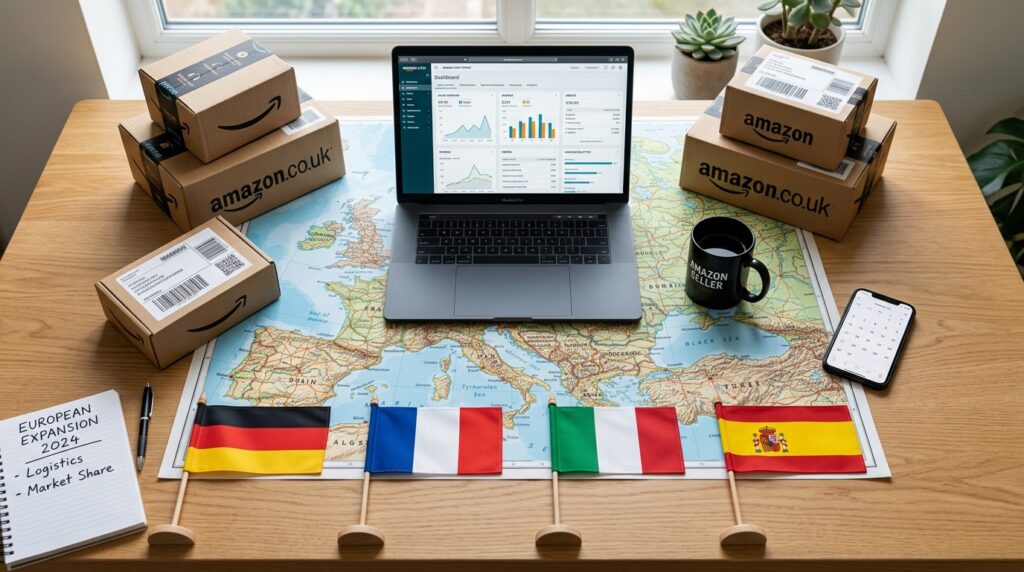
Why European Expansion Is Worth Considering Now
Amazon operates dedicated marketplaces in Germany (amazon.de), France (amazon.fr), Italy, Spain, the Netherlands, Sweden, Poland, and Belgium — giving sellers access to hundreds of millions of potential customers across the EU. For sellers who have already found their footing on Amazon UK or in their home market, moving into Europe is one of the most logical next steps for growth.
That said, international expansion on Amazon is not simply a matter of copying your existing listings and switching the currency. Each European market has its own language, consumer expectations, tax obligations, and logistics considerations. Getting the fundamentals right before you launch will save you considerable time and money further down the line.
Understanding the European Amazon Ecosystem
Amazon groups its European marketplaces under a single unified account structure. When you register as a seller on Amazon.co.uk or any European marketplace, you can use the Build International Listings (BIL) tool to extend your catalogue to other EU stores. Amazon will automatically create offers in target marketplaces, translate prices based on your rules, and synchronise inventory — though the quality of automated translations is variable and should not replace proper localisation.
It is worth noting that although your seller account spans multiple marketplaces, Amazon treats performance, reviews, and account health metrics separately for each one. A suspension or policy violation on one marketplace does not automatically affect the others, but it does demand your attention quickly. sellers looking for structured support often find that having a dedicated account management partner makes it much easier to monitor health across several stores simultaneously.
Key Steps Before You Launch in a New European Market
1. Research Demand and Competition in Each Market
Do not assume that a product selling well in the UK will perform equally well in Germany or France. Consumer preferences, price sensitivity, and category competition differ significantly by country. Use Amazon’s own data tools, such as Brand Analytics if you have Brand Registry, alongside third-party keyword research tools, to understand search volume and buying behaviour in each target marketplace. Germany is typically the largest and most competitive EU marketplace, making it a strong priority — but also a harder one to crack without proper preparation.
2. Localise Your Listings Properly
Machine-translated listings rarely perform well. German, French, Italian, and other European shoppers expect product titles, bullet points, and descriptions written naturally in their own language, using terminology they would genuinely search for. Hiring a native-speaking translator with e-commerce experience is a worthwhile investment. Poor localisation leads to low click-through rates, weak conversion, and sometimes policy violations if regulatory language is mistranslated.
3. Understand VAT Obligations
VAT compliance is one of the most commonly misunderstood aspects of selling across EU marketplaces. Since the EU’s One Stop Shop (OSS) scheme came into effect, sellers can in some circumstances handle cross-border B2C VAT through a single registration — but this depends on your business structure, storage location, and sales volumes. Sellers storing goods locally in Germany, France, or Poland through Amazon FBA (Fulfilled by Amazon) will generally need to register for VAT in those countries individually. Requirements vary by country and seller situation, so it is essential to work with a qualified tax adviser who has specific experience in EU e-commerce before you begin selling. This article is not tax advice and rules may have changed since publication.
4. Choose Your Fulfilment Model Carefully
Amazon’s Pan-European FBA programme allows Amazon to redistribute your inventory across its EU fulfilment centres to reduce delivery times. The trade-off is that it can trigger VAT obligations in multiple countries simultaneously, since your stock may end up stored in several EU nations. European Fulfilment Network (EFN) is a less complex alternative — your inventory stays in one country and ships cross-border when orders come in from other marketplaces. EFN typically results in slightly longer delivery times and higher per-unit fees, but the tax situation is more straightforward for sellers just starting out in Europe.
For sellers who prefer to manage their own logistics, Fulfilled by Merchant (FBM) is also available across EU marketplaces, though meeting Amazon’s delivery time expectations from outside a country can be challenging. You can find a detailed breakdown of both fulfilment approaches at https://smartbuyers.ie/amazon-sales-services/.
5. Adapt Your Pricing Strategy Per Market
Pricing that works in the UK will not automatically be competitive in Germany or competitive enough to win the Buy Box in France. Factor in local FBA fees, return rates (Germany has notably high return rates, particularly in clothing and footwear), marketplace referral fees, VAT-inclusive pricing requirements, and local competitor pricing. Use Amazon’s fee calculators and test your margins carefully before committing significant inventory to a new marketplace.
6. Prepare for Higher Return Volumes
European consumer protection laws are generally stronger than those in some other markets. EU buyers have a statutory right to return most goods within 14 days under the Consumer Rights Directive, without giving a reason. Amazon’s own return policies in Europe often go further than the legal minimum. Build realistic return rates into your margin calculations, and ensure your FBA returns handling or FBM returns process is set up correctly from day one.
Managing Multiple Marketplaces Without Losing Control
Scaling across five or more European marketplaces simultaneously introduces significant operational complexity. You will need to monitor listing health, inventory levels, advertising campaigns, customer messages, and performance metrics across each store — often in different languages. Many sellers find that this is where their early momentum stalls.
Having professional support in place from the beginning can make an enormous difference. The https://smartbuyers.ie/amazon-seller-account-management-service-outsourcing/ page outlines how Smartbuyers approaches account management on behalf of sellers, covering everything from listing maintenance to performance monitoring across multiple EU stores.
For sellers also interested in reaching business customers, it is worth noting that Amazon Business operates across several European markets. Registering for Amazon Business features allows you to offer VAT-exclusive pricing and quantity discounts to B2B buyers — a meaningful advantage in categories like office supplies, tools, or industrial products. More information is available at https://smartbuyers.ie/amazon-business-free-b2b-account-on-amazon/.
A Realistic Timeline for European Expansion
- Weeks 1–2: Market research, demand validation, and competitive analysis for priority marketplaces
- Weeks 3–4: VAT advice, account structure review, and fulfilment model decision
- Weeks 5–8: Listing localisation, pricing strategy, and inventory planning
- Week 9 onwards: Launch, early advertising tests, and performance monitoring
This is a compressed timeline. Many sellers take three to six months to launch properly, and that is not a failure — it is due diligence. Rushing into a new marketplace without the groundwork in place leads to wasted ad spend, VAT headaches, and poor organic rankings that can take months to recover.
Taking the Next Step
European expansion on Amazon is genuinely achievable for sellers of all sizes, but it rewards those who plan carefully and treat each market as its own entity rather than a copy-paste exercise. If you are weighing up where to start or need a clearer picture of what the process involves, the Smartbuyers resource library covers many of the practical challenges sellers face at every stage of international growth.
Equally, if you are already selling in one or two European markets and want to accelerate your expansion in a more structured way, speaking to a specialist team early in the process is often the most cost-effective decision you can make. Visit https://smartbuyers.ie to find out how Smartbuyers works with brands and sellers across European Amazon marketplaces.