The Fulfilment Decision That Shapes Your Entire Amazon Business
One of the most consequential choices any Amazon seller makes is how they handle fulfilment. Get it right and your operation runs smoothly, your costs stay manageable, and customers receive their orders on time. Get it wrong and you can find yourself drowning in storage fees, handling complaints, or struggling to compete for the Buy Box.
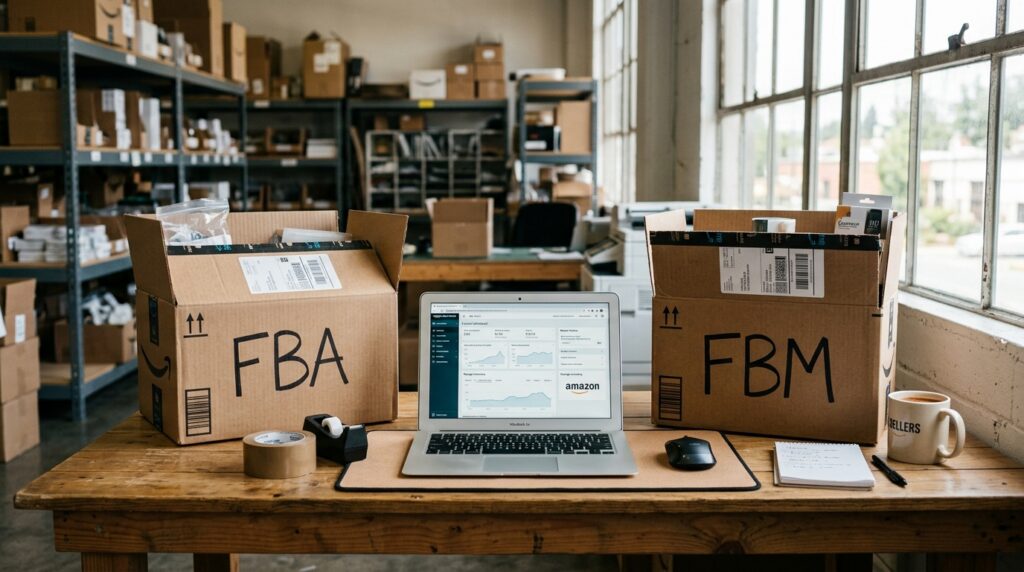
Amazon offers two primary models: Fulfilment by Amazon (FBA) and Fulfilment by Merchant (FBM). Both have genuine strengths, and neither is universally superior. What matters is understanding which model suits your specific products, margins, and growth plans.
What Is FBA and How Does It Work?
With FBA, you send your inventory to Amazon’s fulfilment centres, and Amazon takes responsibility for storing, picking, packing, and shipping your products to customers. Amazon also handles customer service and returns for FBA orders.
The key advantages are clear:
- Your listings typically qualify for Prime, giving customers fast, free delivery.
- Amazon’s logistics network is vast and reliable, particularly across Europe and North America.
- You free up significant time that would otherwise be spent on packing and dispatching orders.
- FBA products often have an edge in Buy Box eligibility.
However, FBA is not free of complications. You will pay fulfilment fees based on size and weight, as well as monthly storage fees. Long-term storage fees apply if your stock sits in Amazon’s warehouses for extended periods without selling. For low-margin or slow-moving products, these costs can erode profitability quickly. Amazon also has strict labelling and packaging requirements that sellers must follow precisely before sending stock to a fulfilment centre.
What Is FBM and When Does It Make Sense?
With FBM, you store inventory yourself — in your own warehouse, a third-party logistics provider, or even at home if you are just starting out — and you dispatch orders directly to customers when they come in. You are responsible for packaging, shipping, and in most cases, handling customer enquiries and returns yourself.
FBM gives you considerably more control over your operations. You are not subject to Amazon’s warehousing constraints, and you avoid FBA storage fees entirely. This makes FBM particularly attractive for:
- Large, heavy, or oversized products where FBA fulfilment fees would be prohibitively high.
- Products with unpredictable or seasonal demand where storage fees could accumulate.
- Sellers with existing warehouse infrastructure and reliable shipping arrangements.
- Items that require special handling or packaging not easily managed by Amazon’s fulfilment centres.
- Handmade, bespoke, or made-to-order goods.
The trade-off is that FBM sellers must consistently meet Amazon’s strict performance metrics: on-time delivery rate, order defect rate, and cancellation rate. Falling below Amazon’s thresholds can lead to listing suppression or, in serious cases, account suspension. FBM listings also typically do not carry the Prime badge unless the seller qualifies for Seller Fulfilled Prime — a programme with demanding eligibility criteria.
Comparing the Real Costs
Many sellers choose FBA because it feels simpler, but the cost comparison deserves careful attention. FBA fees vary by marketplace, product category, and product dimensions. Amazon updates its fee structures periodically, so it is essential to check the current fee schedule on the relevant Amazon marketplace rather than relying on outdated figures.
When evaluating costs, sellers should factor in:
- FBA: Fulfilment fees per unit, monthly storage fees, long-term storage fees, inbound shipping costs to Amazon, and potential disposal or removal fees.
- FBM: Your own postage and packaging costs, warehouse rent or third-party logistics fees, staff time, and the cost of returns management.
A useful exercise is to run the numbers on your best-selling products under both models. Amazon’s Revenue Calculator, available within Seller Central, can help you estimate FBA fees against your own fulfilment costs. The right answer will differ from product to product, which is why many experienced sellers actually use both models simultaneously — FBA for fast-moving lines and FBM for bulky or lower-velocity products.
The Impact on Buy Box Eligibility and Visibility
FBA does offer a practical advantage when it comes to the Buy Box, primarily because Amazon can guarantee fast and reliable delivery through its own network. Prime eligibility is a significant factor for many shoppers, and FBA listings carry it automatically.
That said, FBM sellers are not locked out of the Buy Box. Competitive pricing, strong seller metrics, and fast handling times all play a role. Sellers who are disciplined about their FBM performance can and do win the Buy Box regularly, particularly in categories with less competition or for products they sell exclusively.
Thinking About B2B Opportunities on Amazon
Both FBA and FBM sellers can take advantage of Amazon’s business-to-business features, including quantity pricing, VAT-exclusive pricing for business customers, and enhanced invoicing. If you are selling products that appeal to trade buyers, retailers, or institutional purchasers, it is worth exploring what Amazon Business offers. You can read a detailed breakdown of how it works for sellers at https://smartbuyers.ie/amazon-business-free-b2b-account-on-amazon/.
When Professional Support Makes a Difference
Choosing between FBA and FBM is rarely a one-time decision. As your catalogue grows, your logistics situation changes, or you expand into new marketplaces, you may find that the optimal model shifts. Many sellers who are scaling across multiple Amazon marketplaces — particularly across Europe — find the complexity of managing fulfilment, account health, and listing optimisation simultaneously becomes genuinely overwhelming.
This is where working with specialists can make a measurable difference. The team at https://smartbuyers.ie supports sellers at every stage of their Amazon journey, from initial account setup through to international expansion. Their account management and outsourcing service, described at https://smartbuyers.ie/amazon-seller-account-management-service-outsourcing/, is designed for sellers who want professional oversight of their Amazon operations without building an in-house team.
Whether you are trying to reduce the time you spend managing fulfilment exceptions or need help optimising your catalogue for both FBA and FBM performance, the https://smartbuyers.ie/amazon-sales-services/ page gives a clear picture of what kind of ongoing support is available.
Making the Right Choice for Your Business
There is no single correct answer to the FBA versus FBM question. The decision should be driven by your product characteristics, your margin structure, your existing logistics capability, and your capacity to manage customer service to the standard Amazon requires.
A practical starting point: audit your current or planned product range, calculate your true fulfilment costs under each model, and consider your growth ambitions. If you are planning to expand internationally, FBA through Amazon’s European Fulfilment Network or Multi-Country Inventory programme may simplify cross-border logistics considerably. If you are selling heavy or high-value items with strong margins, FBM with a reliable courier contract may serve you better.
For sellers who want to learn more about building a sustainable Amazon operation, the Smartbuyers resource hub covers a wide range of practical topics for sellers at every stage. And if you are still early in your thinking about how to structure your Amazon presence, the guides and insights on the Smartbuyers blog are a worthwhile place to start building your understanding before committing to a fulfilment strategy.
The sellers who thrive on Amazon are typically those who treat fulfilment not as a background operational detail but as a core part of their competitive strategy. Whichever model you choose — or combination of both — make that choice deliberately and revisit it regularly as your business evolves.